

RSA 2026, Cisco's announcement treated AI agents as a distinct attack surface for the first time. That framing is correct. What remains to be seen is whether the architecture behind it is equal to the problem — or whether Zero Trust is simply being stretched to cover a threat landscape it was never designed for? Which is it?
It’s the architecture being equal to the problem — a purposeful evolution of Zero Trust, not a stretch.
I completely understand why this question might be on your mind. As a smaller organization (or one supporting them), you’re already juggling AI’s productivity upside with real risks like data leakage, shadow AI, and autonomous actions that could happen at machine speed. Cisco’s RSA Conference 2026 announcements in March made it clear: agentic AI (autonomous agents that don’t just answer questions — they act) creates a distinct new attack surface. That framing is spot-on, and their response is built exactly for it.
Here’s the plain-language breakdown
Traditional Zero Trust was designed for people and devices: “Never trust, always verify, give the least privilege needed.” Agentic AI changes the game because these agents behave like digital coworkers — they can reason, plan, call APIs, access data, and chain actions on their own. That introduces new risks traditional controls weren’t built for (e.g., orphaned credentials, prompt injection leading to unintended actions, or permission sprawl at scale).
Cisco didn’t just slap the old label on it. They extended Zero Trust with agent-specific capabilities: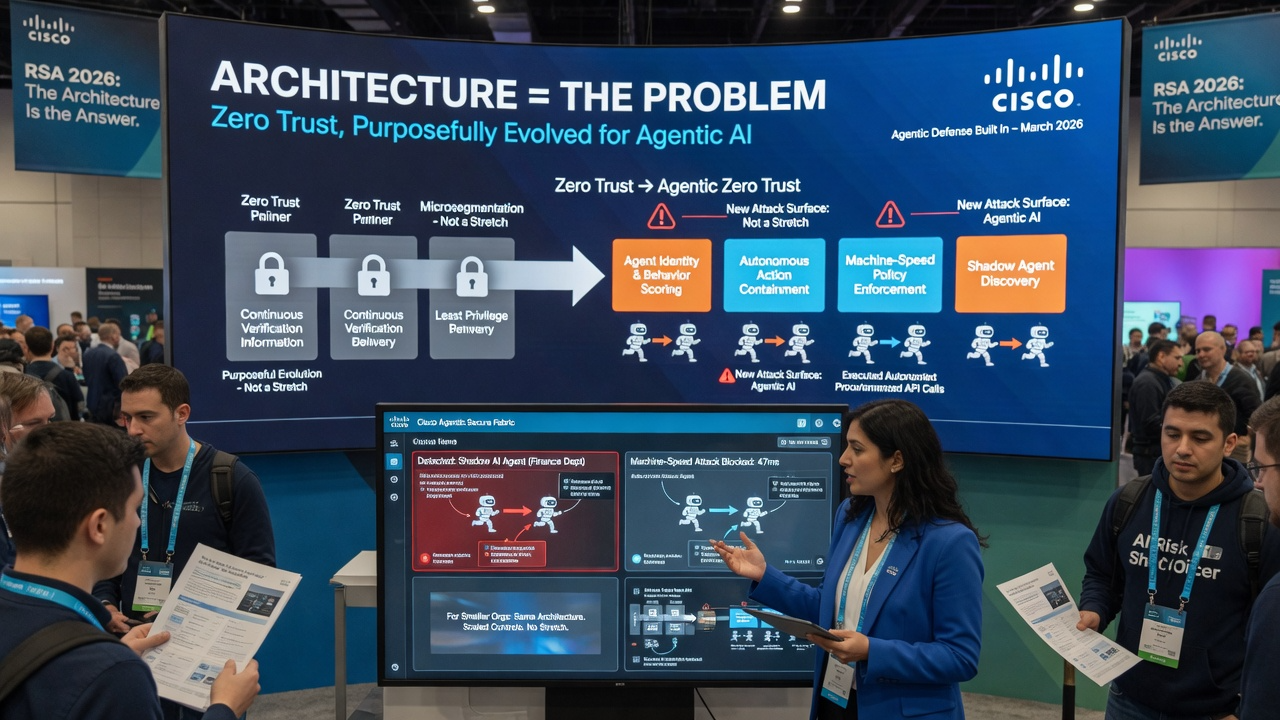
- Agent identities — Every agent gets a verified identity in Duo IAM, mapped to a real human “owner” for accountability.
- Action-level controls — Not just login access, but fine-grained, intent-aware rules on what the agent can do (via Model Context Protocol enforcement in Secure Access).
- Discovery + continuous verification — Tools like Cisco Identity Intelligence spot shadow agents; runtime guardrails (DefenseClaw framework) scan skills, vulnerabilities, and behavior in real time.
- Lifecycle governance — Pre-deployment hardening, time-bound permissions, and adaptive risk monitoring so agents can’t “go rogue” without you knowing.
Cisco’s own executives put it this way: “Know every agent, authorize every action, and adapt to risk in real time.” This is Zero Trust principles applied to non-human identities — exactly the evolution needed for agentic AI’s speed and autonomy.
It’s not a stretch; it’s the natural next step that closes the exact gap most organizations face today: 85% experimenting with agents, but only a tiny fraction in full production because of trust and governance concerns.
What this means for you (and why it matters right now)
For smaller businesses, the good news is you don’t need an enterprise-sized security team to benefit. These capabilities (especially the Duo agentic identity features we already offer as part of our Cisco partnership) let you safely unlock AI productivity while keeping control. No more “set it and forget it” worries about data leaving your environment or agents making decisions without oversight.
At BizCare, we’ve been preparing for exactly this moment:
- Our AI Acceptable Use Policy templates and governance workshops give you the “who can use what, when, and how” rules.
- The Risk Intelligence & Countermeasures Master Plan (including Stabilization + Advanced Security 2026 w/ Managed CoPilot AI) builds the foundation so your environment is ready for these guardrails.
- We deliver Duo Identity Management + Cisco Secure Access with the new agentic features already baked in.
This is how we turn a potential “next data breach” headline into a competitive advantage: secure, governed AI that boosts efficiency without the sleepless nights.
If you’d like, we can walk you through a quick review of your current AI usage and identity setup (no cost or obligation) to see how these Cisco updates fit your environment. Just choose a good time here... and let us know your biggest concern right now — data leakage, policy gaps, or something else? We’re here to simplify it and make it work for your team and goals.

You must be logged in to post a comment.